
Tamoghno Das
My research focuses on efficient collaborative AI systems and hardware–software co-design for intelligent edge platforms. I am particularly interested in reducing the computation, communication, and memory overhead of multi-sensor perception and modern deep learning models while preserving accuracy and real-time performance. My work spans efficient sensor fusion, edge AI, processing-in-memory architectures, and resource-aware machine learning for autonomous and embodied systems.
A central theme of my current research is using world knowledge as a prior to make multi-agent perception, fusion, reasoning, and inference more efficient. Such prior knowledge may include physical topology, spatial relationships, sensor geometry, temporal structure, task semantics, and known interaction patterns among agents. By incorporating these structural priors, collaborative systems can selectively process, communicate, and fuse only the information that is relevant to the task, rather than modeling all possible interactions. My current work applies this principle to scalable roadside multi-radar perception, where deployment geometry and field-of-view overlap are used to construct sparse attention patterns that reduce fusion complexity while preserving perception accuracy. More broadly, I aim to develop resource-efficient collaborative intelligence systems that use structured knowledge to operate under stringent latency, energy, bandwidth, and memory constraints.
I previously earned a Master’s degree in Electrical Engineering from the Indian Institute of Technology, Delhi. Explore my Publications, Talks, Teaching, or view my CV.
Latest News
Our work on robust reasoning and learning with brain-inspired representations under hardware-induced nonlinearities appeared at GLSVLSI 2025. Read more
Our paper, Neuro-Photonix, was published in the IEEE Transactions on Circuits and Systems for Artificial Intelligence. Read more
We introduced LVLM_CSP, a framework for accelerating large vision-language models for reasoning segmentation. Read more
Talks
- Processing-in-memory (PIM) architectures and systems
- Machine learning accelerator hardware/software co-design
- Energy-efficient AI architectures (HDC, SNN)
- Neurosymbolic AI
Featured Talk
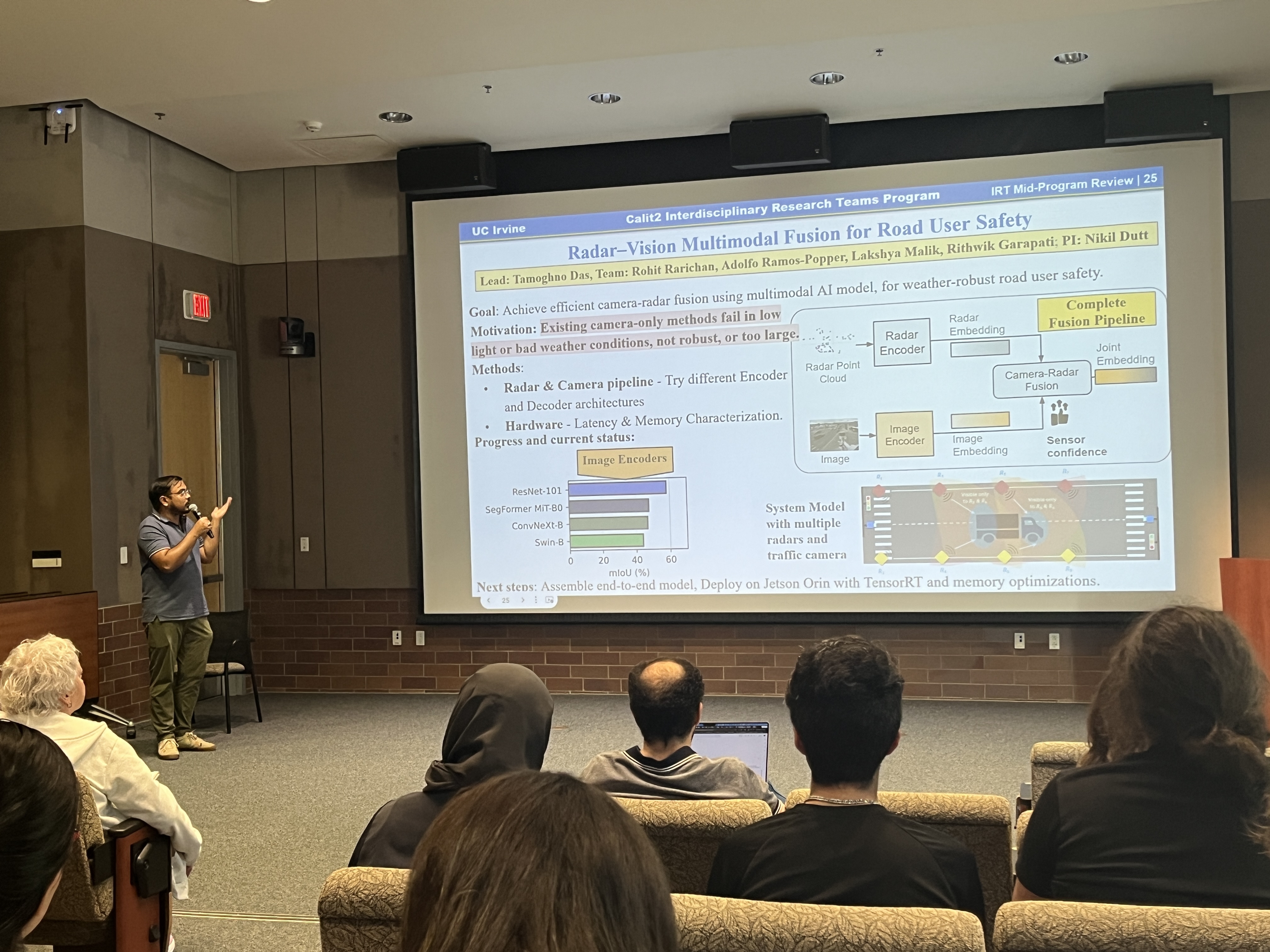
I presented our work on radar-vision multimodal fusion for road user safety at UC Irvine’s Calit2 Interdisciplinary Research Teams mid-program review, highlighting robust camera-radar fusion pipelines for low-light and adverse weather driving conditions.
Teaching
- FQ’ 2025 — CS178: Machine Learning and Data Mining, Teaching Assistant
- SQ’ 2025 — ICS51: Introduction to Computer Organization, Teaching Assistant
- WQ’ 2025 — CS151: Digital Logic Design, Teaching Assistant
- FQ’ 2024 — ICS51: Introduction to Computer Organization, Teaching Assistant
- WQ’ 2024 — ICS51: Introduction to Computer Organization, Teaching Assistant
- FQ’ 2023 — ICS32A: Python Programming with Libraries, Teaching Assistant